
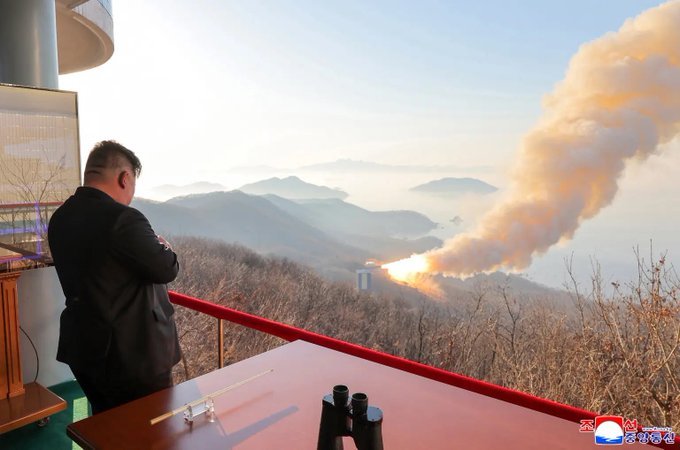
North Korean leader Kim Jong Un observed a ground test of a newly upgraded, high-thrust solid-fuel rocket engine on Saturday, March 28, 2026, state media reported on Sunday. The test, which utilized advanced composite carbon fiber materials, is seen as a major step toward developing intercontinental ballistic missiles (ICBMs) capable of carrying multiple warheads to the United States mainland.
A 26% Leap in Power
According to the Korean Central News Agency (KCNA), the ground jet test achieved a maximum thrust of 2,500 kilonewtons (kN).
- Significant Upgrade: This marks a 26% increase in power from the 1,971 kN recorded during a similar test in September 2025.
- The “Hwasong-20” Speculation: Analysts suggest this engine is likely intended for the Hwasong-20, a next-generation ICBM currently under development.
- Multi-Warhead Ambitions: Experts note that the increased thrust is essential for launching Multiple Independently Targetable Reentry Vehicles (MIRVs), which allow a single missile to strike several targets simultaneously, complicating U.S. missile defense efforts.
“Highest Level of Strategic Muscle”
Kim Jong Un expressed “great satisfaction” with the results, characterizing the test as a “significant phase of change” for the nation’s strategic forces.
- Strategic Modernization: Kim stated that the test “fully satisfies” the requirements of the country’s five-year arms build-up plan, which prioritizes the modernization of “strategic strike means.”
- The Solid-Fuel Advantage: Unlike older liquid-fuel rockets, solid-fuel engines allow missiles to be stored fueled and launched with almost no notice, making them significantly harder for foreign intelligence to detect and preempt.
- A “Different Status” than Iran: In a speech at the North Korean Parliament just days prior, Kim reportedly emphasized that North Korea’s status as a nuclear power is “irreversible,” pointedly contrasting his country’s established deterrent with the ongoing conventional conflict involving Iran.
Context: A Multi-Domain Display of Force
The engine test was part of a broader weekend of military activity for the North Korean leader.
- Active Defense Tank: Kim also oversaw an “interception test” for a new main battle tank. State media claimed a “100% success rate” for the tank’s active defense system, which reportedly intercepted anti-tank missiles and drones mid-flight. Kim boasted that “no global tank” can match its capabilities.
- Special Forces Drills: A separate report showed Kim inspecting a special forces training base, where soldiers demonstrated demolition and martial arts skills.
- Diplomatic Signaling: At a Workers’ Party congress in February, Kim left the door open for dialogue with President Trump but maintained a hardline stance, demanding Washington drop all nuclear disarmament prerequisites.
| Metric | September 2025 Test | March 2026 Test |
| Maximum Thrust | 1,971 kilonewtons | 2,500 kilonewtons |
| Material Used | Traditional Composites | Composite Carbon Fiber |
| Strategic Goal | ICBM Foundation | MIRV / Global Strike Range |
| Launch Readiness | High (Solid Fuel) | Immediate (Solid Fuel) |
Regional and International Reaction
While North Korea celebrated the test, some international experts remain skeptical of the “100% success” claims. Lee Choon Geun, a fellow at South Korea’s Science and Technology Policy Institute, suggested the report might include “bluffing” as it omitted critical data like total combustion time. However, the U.S. and its allies are expected to monitor the situation closely, as any advancement in MIRV technology significantly alters the nuclear balance of power in the Pacific.
