
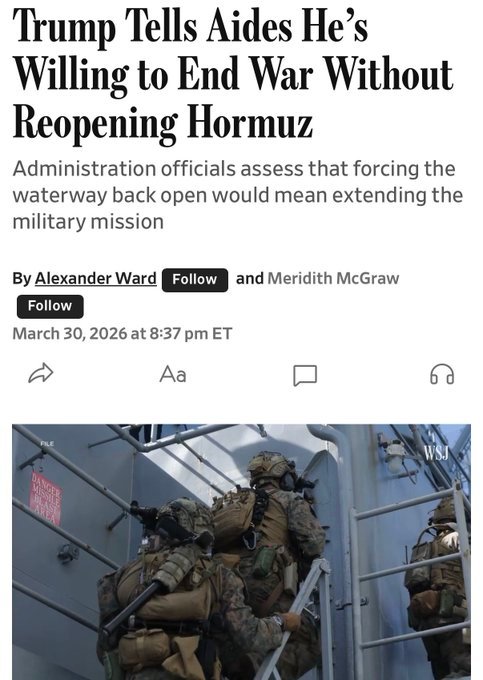
In a significant strategic pivot, President Donald Trump has privately informed senior aides that he is prepared to conclude the current U.S. military campaign against Iran even if the Strait of Hormuz remains largely closed to global shipping. The report, first detailed by The Wall Street Journal (WSJ) on Monday night, March 30, 2026, indicates a shift toward a shorter, high-intensity conflict rather than a protracted campaign to secure international waterways.
The New Strategy: “Strike and Exit”
According to administration officials, the White House has concluded that a mission to forcibly pry open and secure the Strait would require a much longer and riskier military commitment than the President is willing to authorize.
- Core Military Objectives: Instead of a total reopening, the administration is focusing its current fire on four specific pillars:
- Crippling the Iranian Navy to prevent future maritime harassment.
- Decimating Missile Stockpiles to remove the threat to regional allies.
- Degrading the Defense Industry to stall long-term military recovery.
- Neutralizing Strike Capacity to prevent retaliation against U.S. assets.
- The Timeline: Trump is reportedly aiming to achieve these objectives within a four-to-six-week window, after which he intends to wind down kinetic operations and shift to diplomatic pressure.
The Diplomatic Gamble
By stopping short of restoring “freedom of navigation,” the U.S. is essentially betting that Tehran can be pressured at the negotiating table to reopen the Strait voluntarily.
- Allied Burden-Sharing: If diplomacy fails, the WSJ reports that Washington plans to press its allies in Europe and the Gulf to take the lead in any future “cleanup” or security operations in the waterway.
- The “Not Our Oil” Stance: Senior officials have begun downplaying the Strait’s importance to the U.S. directly, noting that while it carries 20% of the world’s oil supply, it is far more critical to Asian and European markets than to a now energy-independent United States.
Economic and Political Risks
This “major gamble” carries significant risks for the global economy and the domestic American landscape:
- Sustained Energy Shock: Leaving the world’s most important energy chokepoint even partially blocked ensures that oil prices—which recently crossed $120 per barrel—will remain volatile, continuing the economic pain of the war long after the bombing stops.
- The $4 Gallon Reality: On Monday, the U.S. national average for gasoline crossed $4 a gallon for the first time in over three years, a political liability Trump is reportedly keen to address by ending the active war quickly.
- The “Islamabad Track”: This shift in military strategy provides a backdrop for the ongoing peace talks in Pakistan. Trump is signaling to Tehran that he is willing to leave them in a “self-imposed blockade” while the U.S. walks away, effectively daring the Iranian government to survive under a total maritime and economic siege.
| Feature of New Policy | Status / Shift |
| Primary Goal | Destroy IRGC assets (Navy/Missiles) |
| Hormuz Status | Deferred to Diplomacy or Allies |
| U.S. Timeline | 4–6 Weeks (Targeted Exit) |
| Market Impact | High (Energy prices likely to remain elevated) |
| Negotiation Basis | The “15-Point Plan” via Islamabad |
A “Dangerous Opportunity”
While the President’s “Strike and Exit” strategy avoids the quagmire of a ground war or a long-term maritime occupation, it leaves the geopolitical map fundamentally altered. As Secretary of State Marco Rubio noted, once the primary military targets are neutralized, the burden of reopening the Strait will “depend on Iran, or on an international coalition,” effectively marking a new era of American “selective engagement” in the Middle East.
