
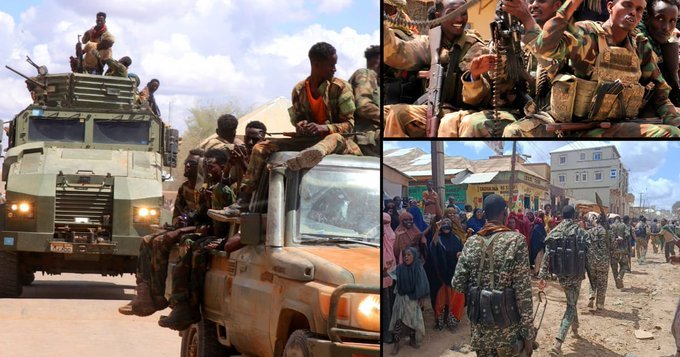
The Somali Federal Government achieved a major military and political breakthrough on Monday, March 30, 2026, as the Somali National Army (SNA) seized full control of Baidoa, the administrative capital of South West State. The takeover prompted the immediate resignation of the regional president, Abdiaziz Hassan Mohamed “Laftagareen,” effectively ending a two-week standoff that threatened to plunge the region into civil war.
The Sudden Fall of Baidoa
Following days of tension and the strategic positioning of federal troops, the SNA moved into the city early Monday morning.
- “Ghost Town” Conditions: Local elders described Baidoa as a “ghost town” during the transition, as many residents fled to the outskirts fearing heavy urban combat between federal forces and regional “Darwish” paramilitaries.
- Federal Welcome: By Monday afternoon, the Federal Ministry of Information announced that the army had been “welcomed” by the population and that the city had been stabilized.
- Administrative Collapse: With the SNA occupying key government buildings and the airport, the regional administration’s grip on power evaporated within hours.
The Resignation of Laftagareen
Shortly after the city fell, President Abdiaziz Laftagareen posted a statement on Facebook confirming his resignation.
- A Short-Lived Term: Remarkably, his resignation comes just days after he was reportedly re-elected for a second five-year term by the regional parliament—an election the federal government in Mogadishu had refused to recognize.
- The “Militia” Accusation: In his final communications, Laftagareen accused the federal government of arming local militias to destabilize the state and using “unconstitutional” means to centralize power.
- Political Context: Laftagareen had recently resigned from President Hassan Sheikh Mohamud’s political party, signaling a total rupture before the military move.
Roots of the Conflict: The March 17 Break
The military intervention was the culmination of a rapid diplomatic collapse that began on March 17, 2026, when South West State formally severed all ties with Mogadishu.
- Constitutional Dispute: The primary trigger was the federal government’s push for constitutional amendments that regional leaders claimed would strip away state autonomy.
- The “Domino Effect”: South West State was the third federal member state to suspend cooperation, following Puntland and Jubaland, leading to fears of a total “balkanization” of Somalia.
- Parallel Command: Tensions peaked when Mogadishu appointed its own police commanders in the Bay region, directly bypassing Laftagareen’s authority.
Humanitarian Crisis in a Key Hub
Baidoa is one of Somalia’s most critical humanitarian hubs, housing hundreds of thousands of Internally Displaced Persons (IDPs) fleeing drought and Al-Shabaab.
- Displacement: An estimated 45,000 people were displaced by the tensions leading up to the takeover.
- Aid Suspensions: Several international aid agencies, including MSF and WFP, had partially suspended activities in the days prior due to the risk of clashes.
- Food Security: The instability arrives as nearly 6.5 million Somalis face crisis-level hunger (IPC Phase 3 or higher) due to the ongoing 2025-2026 drought.
| Key Event Metric | Status (March 31, 2026) |
| Current Authority | Somali National Army (Federal) |
| Regional Leadership | Vacant (Following Laftagareen’s resignation) |
| Security Status | “Calm but Tense”; ghost town conditions reported |
| Humanitarian Impact | 45,000 newly displaced; Aid flow restricted |
| Political Alliance | South West State (SWS) back under Federal influence |
Looking Ahead
The fall of Baidoa is a major victory for President Hassan Sheikh Mohamud’s “one-person, one-vote” centralized vision, but it leaves the federal system in a fragile state. While the “rebellion” in South West State has been suppressed, the federal government still faces active non-cooperation from Puntland and Jubaland, making the scheduled national elections later this year a major geopolitical question mark.
