
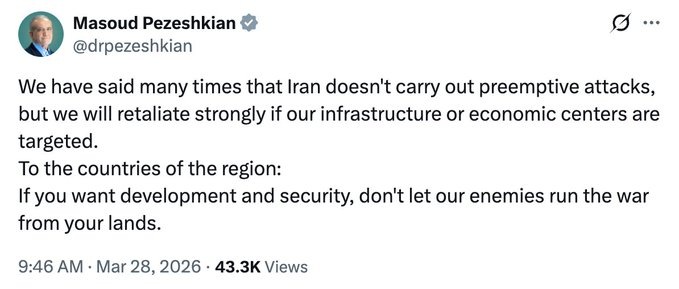
TEHRAN, IRAN — In a direct and pointed message to the Arab states of the Persian Gulf, Iranian President Masoud Pezeshkian warned on Saturday, March 28, 2026, that regional security and economic development are incompatible with the continued use of neighboring lands as launchpads for U.S. and Israeli attacks.
The statement, issued via X (formerly Twitter) and Iranian state media, signals a hardening of Tehran’s stance as the regional war enters its second month.
The “Development vs. War” Framework
President Pezeshkian’s message was a calculated appeal to the economic ambitions of Gulf monarchs, specifically targeting those invested in massive infrastructure projects like Saudi Arabia’s Vision 2030 or the UAE’s global tourism hubs.
- The Core Message: “To the countries of the region: If you want development and security, don’t let our enemies run the war from your lands.”
- Retaliatory Policy: Pezeshkian reiterated that while Iran does not carry out “preemptive” attacks, it will “retaliate strongly” if its own infrastructure—particularly energy and economic centers—is targeted by assets flying from Gulf bases.
- The Implicit Threat: The message suggests that the “Axis of Resistance” no longer views “neutral” neighbors as off-limits if they continue to provide logistical or basing support to the U.S.-led coalition.
Context: A Fragile Neutrality
The President’s warning comes as several Gulf nations struggle to balance their defense pacts with Washington against the physical threat of Iranian missiles:
- Saudi Arabia: Just yesterday, a missile strike on Prince Sultan Air Base (PSAB) damaged a U.S. AWACS and multiple tankers, wounding at least 12 American soldiers.
- Kuwait: Earlier today, Kuwait International Airport suffered “significant damage” to its radar systems following a swarm of drone strikes.
- UAE: Emirati authorities confirmed that debris from a missile interception today started fires in an Abu Dhabi industrial zone, injuring five people.
The “15-Point” Connection
The timing of this rhetoric is likely intended to influence the 15-point U.S. ceasefire proposal. By threatening the safety and development of its neighbors, Iran is attempting to pressure those same neighbors into urging Washington to accept more lenient terms before the April 6 energy strike deadline.
Diplomatic Response: The Islamabad Factor
The warning adds a layer of extreme tension to the upcoming Quadrilateral Summit in Islamabad on Monday.
- The Participants: Foreign Ministers from Turkey, Saudi Arabia, and Egypt are arriving in Pakistan to forge a regional consensus.
- Pakistan’s Role: Prime Minister Shehbaz Sharif, who spoke with Pezeshkian for an hour today, is reportedly trying to separate the “basing issue” from the immediate ceasefire requirements to prevent the peace talks from collapsing.
| Country | Primary U.S. Facility | Recent Incident (March 2026) |
| Qatar | Al Udeid Air Base | Targeted by drones; interceptions over Doha. |
| Saudi Arabia | Prince Sultan Air Base | Direct hit; aircraft damaged; 12+ U.S. casualties. |
| Kuwait | Kuwait Int’l Airport | Radar systems destroyed by drone wave. |
| UAE | Al Dhafra Air Base | Missile debris hit Abu Dhabi industrial zone. |
Developing: Iranian state media reports that following this message, several Gulf nations have privately reached out to Tehran to clarify their “non-belligerent” status, though the U.S. military presence at these bases remains unchanged.
