
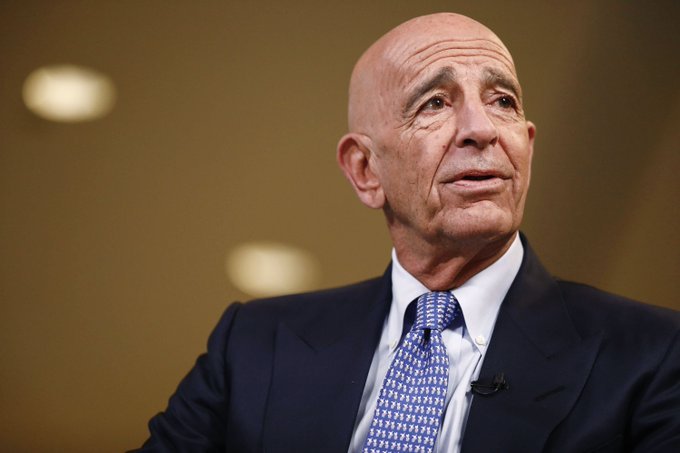
ANKARA / DAMASCUS — In a major re-evaluation of Middle Eastern geopolitics, the U.S. Ambassador to Türkiye and Special Envoy for Syria, Tom Barrack, stated on Saturday, March 28, 2026, that a stabilized Syria is uniquely positioned to become a global energy alternative to the volatile maritime routes of the Strait of Hormuz and the Red Sea.
Speaking at a policy forum, Ambassador Barrack highlighted the revival of the “Four Seas” project—a strategic vision to link the Persian Gulf, Caspian Sea, Mediterranean Sea, and Black Sea through a unified network of pipelines and trade corridors.
Syria: From Conflict Zone to “Stable Alternative”
Barrack noted that while the idea of Syria as a stability anchor would have been “inconceivable” 15 months ago, the collapse of the previous regime and the rise of the transitional government under President Ahmed al-Sharaa have fundamentally changed the calculus.
- Bypassing the Chokepoints: With the Strait of Hormuz effectively closed and the Red Sea under constant Houthi threat, Barrack argued that overland pipelines through Syria and Türkiye provide the most secure route for Iraqi and Gulf energy to reach European markets.
- The “Four Seas” Revival: The project, originally proposed decades ago but stalled by the Assad regime, is now being modernized with U.S. and Gulf backing. It aims to position Türkiye and Syria as the “global switchboard” for regional energy distribution.
- Economic Rebirth: Barrack emphasized that the “rebirth” of Syria must come through “investment and dignity,” moving away from the era of “Western interference” toward regional partnerships.
Key Energy Milestones in the New Corridor
The vision is already being supported by concrete infrastructure agreements signed earlier this year:
| Project | Participants | Objective |
| Kilis-Aleppo Pipeline | Türkiye, Syria | Completed June 2025; supplies 2 billion cubic meters of gas annually. |
| Offshore Exploration | Chevron, Syrian Petroleum Co. | MoU signed Feb 2026 for gas exploration off the Syrian coast. |
| Integrated Power Grid | Türkiye, Syria | 400kV line to be operational by early 2026; 500MW capacity. |
| Mega-Power Plants | Qatar (UCC), U.S. (Power Int’l) | 4,000MW combined-cycle plants in Deir ez-Zor and Mhardeh. |
The Geopolitical Shift: “Shoulder-to-Shoulder”
Barrack’s comments reflect the Trump administration’s broader strategy of “quiet conflict engineering” and regional responsibility.
- Sanctions Relief: Following the historic meeting between Trump and President al-Sharaa in Riyadh, the U.S. and EU have lifted major economic sanctions to facilitate this reconstruction.
- The Turkish Partnership: Barrack, who also serves as the U.S. Ambassador to Türkiye, stressed that Washington is working “shoulder-to-shoulder” with Ankara to ensure the security of these new energy corridors.
“Syria’s tragedy was born in division; its rebirth must come through unity and investment. Pipelines have historically struggled in the Middle East, but a secure, modernized ‘Four Seas’ project is the safest way to power the future.” — Ambassador Tom Barrack
Regional Impact: The “Islamabad” Context
The proposal to make Syria a hub comes just 48 hours before the Islamabad Quadrilateral Summit. While Pakistan, Turkey, Saudi Arabia, and Egypt are primarily focused on an immediate ceasefire, the “Four Seas” project offers a long-term “economic peace” incentive for Iran to de-escalate, as a permanent maritime blockade would only accelerate the shift of energy wealth toward the new Syrian-Turkish corridor.
