
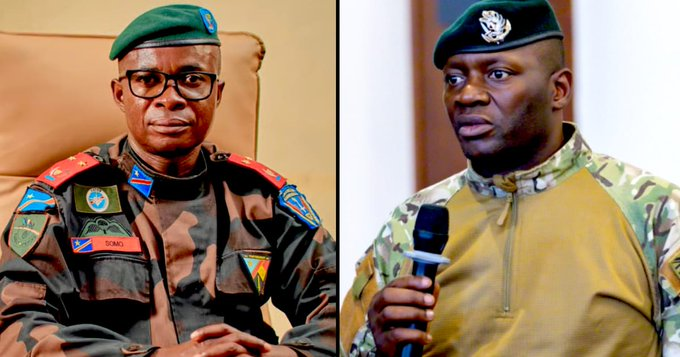
A fog of uncertainty has settled over the eastern Democratic Republic of Congo (DRC) as of Monday, March 30, 2026. While local government officials claim an “effective withdrawal” of M23 rebels from key positions in North Kivu, the rebel leadership has issued a series of contradictory statements, accusing the Congolese army (FARDC) of launching drone strikes that undermine the very ceasefire they are accused of violating.
The Government’s Claim: “Effective Withdrawal”
On Thursday, March 26, the Governor of North Kivu, Evariste Kakule Somo, announced that he had personally observed M23 forces vacating several strategic towns in the Lubero territory.
- Vacated Zones: According to the Governor and reports from Radio Okapi, rebels have moved out of Lunyasenge, Bukununu, Musiya, Katondi, and Kipese.
- The Destination: Security sources indicate that the withdrawing fighters have reportedly regrouped in the Alimbongo, Kirumba, and Kanyabayonga areas.
- The Justification: Governor Somo framed the movement as a “positive step” in the implementation of the Washington Peace Accords—a U.S.-brokered deal signed in December 2025 by Presidents Félix Tshisekedi and Paul Kagame.
The Rebel Counter-Narrative: “Confidence-Building” vs. “Massacres”
The M23 leadership, under the banner of the Congo River Alliance (AFC), has presented a far more volatile version of events.
- Bertrand Bisimwa’s Stance: The AFC/M23 President confirmed a partial withdrawal of 30 km from initial positions—including a retreat from Minova in South Kivu—to “give a chance” to upcoming dialogue in Switzerland.
- The “Kamikaze” Accusation: On Friday, March 27, M23 spokesperson Lawrence Kanyuka accused the Congolese army and government-backed Wazalendo militias of launching overnight drone strikes in the Mikenke locality.
- The Toll: Kanyuka claimed the attacks killed two people, asserting that these “massacres” occurred despite the rebels’ “effective implementation of confidence-building measures.”
A Strategic Stalemate: Goma and the Airports
Despite the reported movement in rural territories, the M23 continues to hold a tight grip on the region’s most critical infrastructure.
- Urban Control: M23 maintains its occupation of Goma (the capital of North Kivu) and Bukavu (the capital of South Kivu), which it seized in a rapid offensive in early 2025.
- Airspace Lockdown: Both Goma International Airport and Kavumu Airport remain closed to commercial traffic. The UN’s acting top envoy, Vivian van de Perre, warned the Security Council last Thursday that M23 is currently “consolidating parallel administrative structures” in these cities, further eroding state authority.
| Location | Reported Status (Mar 30, 2026) | Contested by? |
| Lubero Territory | Partial Withdrawal observed by Gov. | M23 (claims “relocation” only). |
| Minova (S. Kivu) | Withdrawal Confirmed (45km from Sake). | No (consensus on retreat). |
| Goma City | Under M23 Occupation. | No (FARDC unable to retake). |
| Uvira | Recaptured by FARDC in Jan 2026. | No (M23 retreated on US request). |
The “Washington Accords” Under Strain
The confusion on the ground highlights the fragility of the peace brokered by President Donald Trump last year.
- The “Mineral Reward” Critique: Some international observers, including the Oakland Institute, argue the deal is flawed because it grants Rwanda “privileged access” to Congolese resources in exchange for peace—a trade-off that has not stopped the fighting.
- U.S. Sanctions: On March 2, the U.S. Treasury imposed sanctions on the Rwanda Defence Force (RDF) for “blatant violations” of the accords, a move that Kinshasa welcomed but critics labeled “symbolic” given the ongoing M23 presence.
