
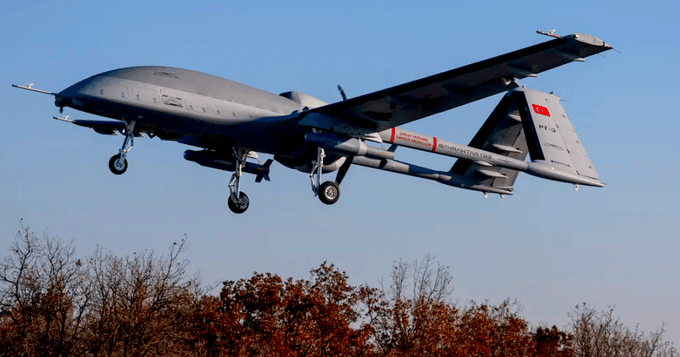
The Chief of Staff of the Italian Navy, Vice Admiral Giuseppe Berutti Bergotto, confirmed on Monday, March 30, 2026, that Italy is actively seeking to acquire the Turkish-made Bayraktar TB3 unmanned combat aerial vehicle (UCAV). Speaking during a parliamentary hearing, Bergotto revealed plans to integrate the drone aboard the Italian flagship, the aircraft carrier Cavour, marking a significant shift in European naval aviation.
The “Steadfast Dart” Breakthrough
The decision follows the TB3’s “flawless” performance during NATO’s Steadfast Dart 2026 exercises in the Baltic Sea last month. While traditional allied assets faced severe operational hurdles, the Turkish drone established a new benchmark for naval reliability.
- Subzero Supremacy: Operating from the Turkish carrier TCG Anadolu, the TB3 successfully conducted 232 autonomous sorties in temperatures reaching –5°C and heavy snowfall.
- Outperforming Allies: As freezing conditions and fierce winds grounded several NATO fighter jets and helicopters, the TB3 remained the only aircraft capable of maintaining stable flight and conducting live-fire missions with MAM-L smart munitions.
- Autonomous Resilience: The drone performed autonomous landings on a runway that had to be manually cleared of ice, earning what Bergotto described as “full marks” from observing allied representatives.
Leonardo-Baykar Partnership: The LBA Systems Model
Italy’s acquisition will be facilitated through LBA Systems, a joint venture established in 2025 between the Italian defense giant Leonardo and the Turkish firm Baykar.
- Industrial Integration: The partnership allows for the integration of European payloads and mission systems onto the TB3 frame, creating a hybrid platform tailored for EU navies.
- Filling the Gap: Defense analyst Riccardo Gasco noted that the TB3 represents the “quickest available answer” to a capability gap that domestic European programs have struggled to fill for decades: a carrier-capable, short-deck unmanned strike system.
- Force Multiplier: Admiral Bergotto characterized the TB3 as a “force multiplier” that will provide the Cavour with persistent surveillance and strike capabilities without the logistical footprint of manned aircraft.
Strategic Shift: The “Drone Carrier” Concept
The interest from the Italian Navy signals the broader adoption of the “drone carrier” doctrine pioneered by Turkey.
- TCG Anadolu vs. Cavour: Both ships share a similar flat-deck, ski-jump design. While the Cavour primarily hosts the F-35B, the addition of TB3s will allow for a high-low mix of stealth fighters and affordable, high-endurance robotic platforms.
- Doctrinal First: NATO observers have noted that using UCAVs to “soften” coastal defenses before amphibious landings—a tactic tested during Steadfast Dart—is a doctrinal first that Italy is now keen to adopt for its own expeditionary strike groups.
| Feature | Bayraktar TB3 Specification |
| Launch/Recovery | Autonomous (Short-deck, no catapult required) |
| Endurance | > 24 Hours |
| Payload | 280 kg across 6 hardpoints |
| Propulsion | TEI-PD200 Turbodiesel Engine |
| Wings | Folding (Designed for shipboard storage) |
Context: A Global Leader in Exports
The Italian interest solidifies Baykar’s position as a dominant force in the global UCAV market. In 2025, the company reported a record export volume of $2.2 billion, with the TB3 already securing its first foreign buyer, Indonesia, earlier this year. For Italy, the move represents a pragmatic pivot toward battle-proven, all-weather technology as the Mediterranean becomes an increasingly complex theater for traditional naval assets.
