
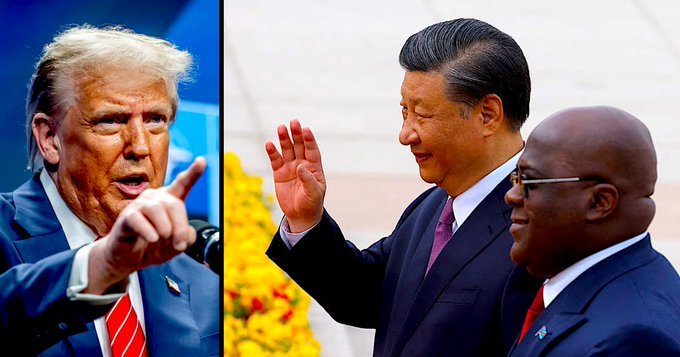
As Washington’s focus remains consumed by the escalating war with Iran, the Democratic Republic of Congo (DRC) and China have signed a sweeping new agreement to deepen their cooperation in the mining sector. The deal, finalized on Thursday, March 26, 2026, reinforces Beijing’s dominance over the world’s largest cobalt reserves at a time when the U.S. is struggling to secure its own “rival pact” with Kinshasa.
The New Agreement: Sovereignty and Data Sharing
The March 2026 framework extends far beyond simple extraction, introducing layers of technical and regulatory integration that analysts describe as a “riposte” to recent American diplomatic efforts.
- Geological Data Sharing: In a move with significant sovereignty implications, the DRC has agreed to share its national geological data with Chinese technical experts to facilitate more efficient exploration.
- Duty-Free Access: Starting May 1, 2026, Congolese mineral exports will receive duty-free access to Chinese markets, creating a direct financial incentive that bypasses Western-led pricing mechanisms.
- Local Processing: Unlike earlier “resource-for-infrastructure” deals, this agreement explicitly promotes the local processing of raw materials within Congo—a key demand of President Félix Tshisekedi to increase the value of the country’s exports.
- Priority Projects: The MIFOR iron ore project in northeastern Congo has been designated as a priority site for Chinese investment under the new framework.
The American Counter-Push: Project Vault and the Lobito Corridor
The Chinese deal arrives just three months after the Trump administration signed its own Strategic Partnership Agreement with the DRC in December 2025.
- The SAR Framework: Under the U.S. deal, the DRC designated a list of “Strategic Asset Reserve” (SAR) zones where American firms were promised preferential access to copper, cobalt, and lithium.
- The Lobito Corridor: Washington has committed over $1 billion to the rehabilitation of the Sakania-Lobito Corridor, a railway designed to bypass Chinese-controlled logistics by transporting minerals westward to Angola’s Atlantic coast.
- Project Vault: This initiative aims to create a $12 billion U.S. strategic stockpile of critical minerals to reduce reliance on Chinese processing. However, with the U.S. currently diverting massive resources to the 82nd Airborne and naval operations in the Persian Gulf, there are growing fears in Kinshasa about the “consistency” of American long-term commitments.
“Hedged Bets”: The Congo’s Dual-Engagement Strategy
Kinshasa is effectively playing both sides of the great power competition to maximize its negotiating leverage.
- The Riposte: Joshua Walker of the Congo Research Group noted that the timing of the China deal, so soon after the U.S. agreement, shows the DRC is “clearly attempting to hedge its bets.”
- Sicomines Audit: Even as it signs new deals, the DRC government launched a technical and financial audit on March 5, 2026, into the Sicomines joint venture (a 2008 China-backed infrastructure-for-minerals project) to ensure that past promises of roads and hospitals have been fulfilled.
| Strategy Component | China (Mar 2026 Deal) | USA (Dec 2025 Deal) |
| Primary Route | Eastern (Standard BRI routes). | Western (Lobito Corridor). |
| Market Incentive | Duty-free access (May 1, 2026). | $12B Stockpile (Project Vault). |
| Key Advantage | Control of 72% of current mines. | Diplomatic security & tech transfer. |
| Local Impact | Integrated industrial zones. | Peace mediation (DRC-Rwanda). |
Global Implications: The Cobalt Bottleneck
The DRC accounts for 70% of global cobalt production, a mineral essential for the electric vehicle (EV) batteries and military hardware that underpin the “super-intelligence race” between the U.S. and China. While the U.S. is preoccupied with the “Strait of Hormuz” crisis, China’s move to secure geological data and local processing rights could effectively lock Western firms out of the next generation of Congolese mining projects.
