
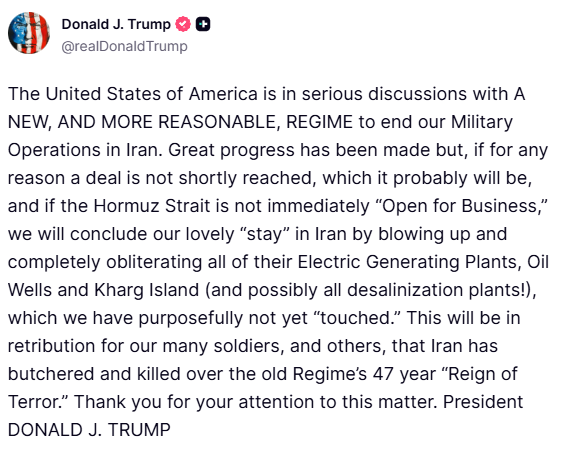
In a major escalation of rhetoric on Monday, March 30, 2026, President Donald Trump used his Truth Social platform to issue what he described as a final warning to Tehran. The President claimed that the United States is in “serious discussions” with a “new and more reasonable regime” to end military operations, but paired this diplomatic outreach with a threat of total infrastructure destruction if a deal is not reached “shortly.”
The “Total Destruction” Ultimatum
The President signaled a shift from surgical strikes to a doctrine of total economic and industrial erasure if the Strait of Hormuz is not immediately reopened to international shipping.
- The Target List: Trump explicitly named electric generating plants, oil wells, and Kharg Island (Iran’s primary oil export hub) as targets that have been “purposefully” spared thus far.
- Expanding the Scope: In a new addition to his previous threats, the President suggested that desalination plants—critical for Iran’s water supply—could also be “obliterated.”
- The Retribution Narrative: Trump framed the potential strikes as “retribution” for American soldiers and citizens killed during what he called the “old Regime’s 47-year Reign of Terror,” a reference dating back to the 1979 Islamic Revolution.
The “New Regime” Mystery
A central and controversial element of the President’s post was the claim that Washington is now dealing with a “new, and more reasonable” leadership in Tehran.
- Regime Change by Attrition: While there has been no formal announcement of a transition in Iran, Trump has recently suggested that the reported death of Supreme Leader Ali Khamenei on March 1 and subsequent strikes on top IRGC leadership have effectively resulted in a “new regime.”
- Tehran’s Denial: Despite Trump’s claims of “great progress” and “productive conversations,” the Iranian Foreign Ministry continues to publicly deny any direct negotiations with the United States, labeling the 15-point U.S. peace plan as “excessive and unreasonable.”
- The “Islamabad Track”: Diplomatic sources indicate that any “serious discussions” are likely occurring through Pakistani intermediaries, who have been facilitating the transfer of messages between the White House and Iranian officials.
Operational Context: The April 6 Deadline
The threat to “conclude our lovely ‘stay'” in Iran follows a 10-day pause in strikes on energy infrastructure that Trump originally announced on March 27.
- The Deadline: This pause is set to expire on April 6. If the Strait of Hormuz remains blocked by that date, military analysts expect a massive air and sea campaign targeting the sites listed in the President’s ultimatum.
- Troop Buildup: The threat comes as the U.S. continues to pour thousands of additional troops into the region, including units from the 82nd Airborne Division, in preparation for a potential ground phase if the “infrastructure wave” fails to break the blockade.
| Target Category | Current Status | U.S. Threat Level |
| Electric Plants | Mostly intact (under 10-day pause). | “Complete Obliteration.” |
| Kharg Island | Operational but under threat. | Blowing up / Potential Seizure. |
| Oil Wells | Sparing to date for “negotiation.” | Total Destruction. |
| Desalination | Not yet targeted. | “Possibly” all plants. |
Market and Regional Reaction
The President’s “obliterate” threat sent immediate shockwaves through global markets and diplomatic circles.
- Energy Prices: Brent Crude spiked toward $118 per barrel following the post, as traders weighed the possibility of a permanent loss of Iranian oil capacity.
- Regional Alarm: Gulf neighbors, including Kuwait and Saudi Arabia, expressed growing concern over the escalation, particularly following a recent Iranian strike on a Kuwaiti desalination plant that killed an Indian worker.
- Domestic Critique: In Washington, top Democrats have accused the President of “fabricating” the progress of negotiations to calm markets while simultaneously planning a massive military escalation.
