
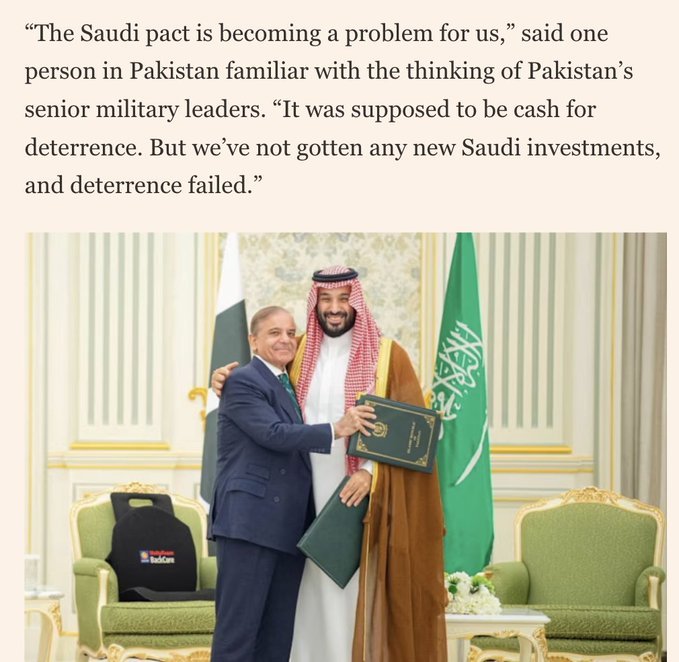
ISLAMABAD / RIYADH — A senior Pakistani official has expressed growing disillusionment with the Strategic Mutual Defense Agreement (SMDA) signed with Saudi Arabia in September 2025. Speaking to the Financial Times on Saturday, March 28, 2026, the source revealed that the “quid-pro-quo” at the heart of the pact is rapidly unraveling as regional violence intensifies.
“The Saudi pact is becoming a problem for us,” the official stated. “It was supposed to be cash for deterrence. But we’ve not gotten any new Saudi investments, and deterrence failed.”
The Failed “Cash for Deterrence” Logic
When the pact was signed six months ago, it was envisioned as a “NATO-style” alliance where Pakistan’s nuclear and conventional military might would act as a shield for Riyadh in exchange for massive economic lifelines.
- The Deterrence Gap: Despite the pact’s clause stating that “any aggression against one is an aggression against both,” Iran has repeatedly struck Saudi soil this month. This includes the major strike on Prince Sultan Air Base yesterday and the ongoing drone swarms targeting the Kingdom’s eastern oil infrastructure.
- The Investment Freeze: Islamabad expected the pact to trigger a $75–100 billion investment wave. However, the source claims that beyond the rolling over of existing $3 billion loans, “new, transformative capital” has not materialized. Saudi Arabia’s shift toward “investment, not aid” (as stated by Finance Minister Mohammed Aurangzeb in February) has proven difficult to implement during an active regional war.
- The “Wait and See” Stance: Riyadh appears to be holding back on major projects, such as the Gwadar oil refinery, until the security situation stabilizes—a delay that the cash-strapped Pakistani government says it cannot afford.
Internal Pressures in Islamabad
The failure of the pact to prevent strikes on Saudi Arabia has put Pakistan’s military leadership in a difficult position:
- Sectarian Risk: Fully operationalizing the pact against Iran would risk severe domestic blowback in Pakistan, which hosts the world’s second-largest Shia population.
- The Afghan Front: Pakistan is already engaged in “open war” with the Afghan Taliban along its northern border. Officials argue that they cannot fulfill their “defense obligations” to Riyadh while their own territory is under threat.
- The Neutrality Trap: Prime Minister Shehbaz Sharif is currently trying to position Pakistan as the “Peace Broker” between the U.S. and Iran. Being tied to a “Mutual Defense” treaty with Iran’s chief regional rival makes this mediation nearly impossible to maintain.
The Road to the Islamabad Summit
These internal frustrations are expected to reach a boiling point during Monday’s Quadrilateral Summit in Islamabad.
| Stakeholder | Primary Goal for Monday |
| Pakistan | Secure immediate financial guarantees and a “basing freeze.” |
| Saudi Arabia | Demand “tangible military support” from Pakistan following the PSAB strike. |
| Turkey & Egypt | Formalize a “Regional Neutrality Bloc” to prevent wider spillover. |
| The U.S. (Observer) | Push for the adoption of the 15-point ceasefire plan. |
Developing: There are unconfirmed reports that the Saudi delegation may bring a “new investment package” to the summit as a final attempt to secure Pakistani military commitments.
