
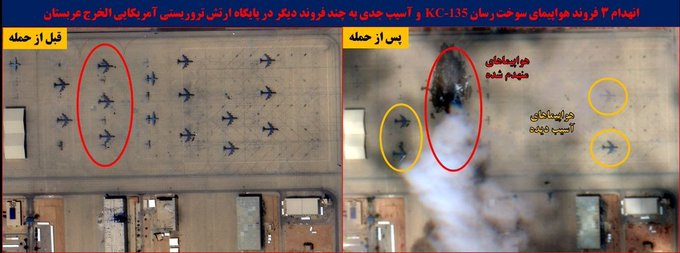
RIYADH / TEHRAN — A war of narratives has erupted over the status of the U.S. aerial refueling fleet at Prince Sultan Air Base (PSAB) in Saudi Arabia. On Friday, March 27, 2026, Iranian state media circulated satellite imagery allegedly showing the wreckage of three U.S. KC-135 Stratotankers following a recent missile strike. However, these claims have been met with a sharp “fact-check” from the White House and independent analysts, who describe the damage as far less catastrophic than Tehran suggests.
The “Satellite War”
The IRGC-affiliated media release claims that a “precision strike” by ballistic missiles successfully neutralized three high-value tankers, which are critical for sustaining the U.S.-Israeli air campaign, Operation Epic Fury.
- Tehran’s Claim: Iranian officials state that the “destruction” of these tankers has created a “logistical black hole” for U.S. fighter jets operating over the Persian Gulf.
- The “Old Photo” Debunk: OSINT (Open-Source Intelligence) analysts and The Aviationist reported today that some of the images circulating in Iranian media were actually from a 1999 incident, quickly identified by digital forensics experts.
- The WSJ Report: Conversely, a widely cited report from The Wall Street Journal—citing two U.S. officials—confirmed that while an attack did take place earlier this month, five KC-135s were damaged on the ground, but none were destroyed.
Trump Responds: “Fake News Headlines”
President Trump took to social media today to personally dispute the characterization of the losses at Prince Sultan Air Base, specifically targeting reports that suggested the aircraft were permanently lost.
“The Base was hit a few days ago, but the planes were not ‘struck’ or ‘destroyed.’ Four of the five had virtually no damage and are already back in service. One had slightly more damage, but will be in the air shortly. None were destroyed, or close to that, as the Fake News said in headlines.” — President Donald Trump
Despite the President’s reassurance, the Pentagon has confirmed that the tanker fleet is under “extraordinary strain,” with roughly 75% of the global KC-135 fleet currently airborne or deployed to support the theater.
The Cumulative Toll on U.S. Tankers
The incident at Prince Sultan Air Base adds to a string of recent setbacks for the U.S. Air Force’s “logistics backbone.”
- The Iraq Crash (March 12): A KC-135 crashed in western Iraq following a near head-on mid-air collision with another tanker. All six crew members were confirmed deceased.
- The Collision Survivor: The second aircraft involved in that collision managed to land at Israel’s Ben Gurion Airport despite losing approximately 40% of its tail and rudder.
- Total Attrition: Between the Saudi strike and the Iraq accident, the U.S. has seen at least seven tankers either destroyed or pulled for major repairs in the last 15 days.
| Location | Status of Tankers | Casualties |
| Prince Sultan AB (Saudi) | 5 Damaged (Being repaired; some back in service). | 0 |
| Western Iraq (Crash) | 1 Destroyed (Mid-air collision). | 6 Deceased |
| Ben Gurion (Israel) | 1 Damaged (Severe tail/rudder damage). | 0 |
What’s Next?
The vulnerability of these “flying gas stations” is a major factor in the 15-point U.S. peace proposal currently in Islamabad. Because U.S. and Israeli jets are operating from bases further afield due to base damage in the Gulf, they are almost entirely dependent on these aging KC-135s. If Tehran continues to successfully target the tanker fleet, the U.S. may be forced to either accelerate the deployment of the newer KC-46 Pegasus or move toward the ground operation that Russia has warned would have “dire consequences.”
