
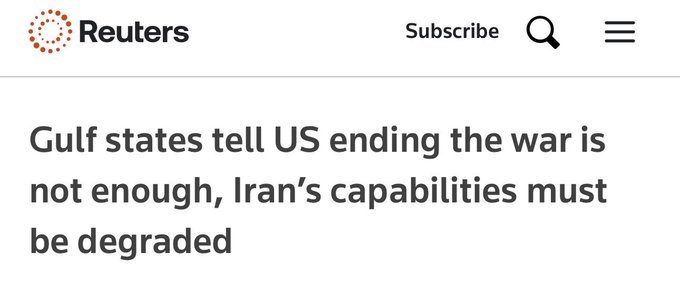
DUBAI / RIYADH — In a significant hardening of their diplomatic stance, the Gulf Arab states have privately informed the United States that a simple end to hostilities is “not enough” to guarantee long-term regional stability. According to a report by Reuters on Sunday, March 29, 2026, a unified front of Gulf nations is now demanding that any peace deal must include the permanent and verifiable degradation of Iran’s missile and drone manufacturing capabilities.
The demand comes as a leaked U.S. intelligence assessment reveals that despite a month of intensive “Infrastructure Blitz” strikes, the U.S. can only confirm the destruction of approximately one-third of Iran’s pre-war missile arsenal.
The “Conclusive Outcome” Mandate
The Gulf position, led by Saudi Arabia, the UAE, and Bahrain, argues that leaving Iran’s offensive capacity intact would merely “freeze” the crisis rather than resolve it.
- Ambassador Yousef Al Otaiba’s Warning: In a widely cited column for the Wall Street Journal, the UAE’s Ambassador to the U.S. framed the conflict as a test of global security. “A simple ceasefire isn’t enough,” Otaiba wrote. “We need a conclusive outcome that addresses Iran’s full range of threats: nuclear capabilities, missiles, drones, terror proxies, and blockades of international sea lanes.”
- Rewriting the Architecture: Gulf officials told Reuters that the Islamic Republic has left them “no diplomatic off-ramp.” They are pushing for a new regional order where Gulf states are written into the “security architecture” of any future settlement.
- Enforceable Restraints: The GCC (Gulf Cooperation Council) is demanding “enforceable” restrictions on Iran’s ability to “weaponize” global energy supplies by closing the Strait of Hormuz.
The “One-Third” Intelligence Gap
The primary driver of this hardened stance is the startling revelation regarding Iran’s surviving inventory.
- Surviving Arsenal: With roughly two-thirds of Iran’s missile stockpile potentially intact in underground “missile cities,” Gulf capitals fear they would remain “hostages” to Tehran the moment U.S. forces withdraw.
- Generational Damage: One Gulf official told Reuters that the goal should be “generational damage” to production sites. While Iran retains the technical knowledge to rebuild, destroying the physical infrastructure would provide a multi-year window to build permanent, impenetrable defenses.
- Refusal of Blackmail: The UAE and Saudi Arabia have signaled they are “ready to absorb an escalation” of the war now, rather than accept a post-war status quo where Iran can still use the Strait of Hormuz as a “bargaining chip.”
A Regional Split on Tactics
While the GCC maintains a unified public front, Reuters reports a subtle divide in “behind-closed-doors” priorities:
| Stance | Nations | Key Concern |
| The Hardliners | Saudi Arabia, UAE, Bahrain | Demand total dismantling of missile/drone production; ready for escalation. |
| The De-escalators | Qatar, Oman, Kuwait | Pushing for a swift end to war to stop economic fallout and avoid direct reprisals. |
| The “Red Line” | All GCC Members | Oppose “boots on the ground” (e.g., Kharg Island), fearing it would trigger a total regional collapse. |
What’s Next?
This “maximalist” demand from the Gulf allies complicates President Trump’s 15-point peace proposal currently being discussed in Islamabad. While Trump has expressed a desire to avoid a “forever war,” his regional partners are essentially asking him to finish the job. If the April 6 deadline passes without a deal that satisfies these security guarantees, the coalition may be forced to transition from air strikes to the “targeted ground operations” recently considered by the Pentagon.
