
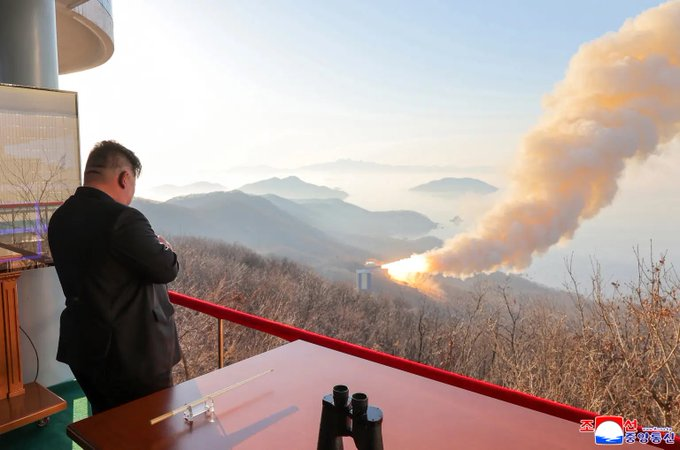
PYONGYANG – North Korean state media (KCNA) reported on Sunday, March 29, 2026, that leader Kim Jong Un personally supervised a successful ground jet test of a newly upgraded, high-thrust solid-fuel engine. The test, conducted at an undisclosed location, is being hailed by officials as a “great significance” in elevating the country’s strategic military power to its highest level yet.
The development is part of a five-year arms build-up plan aimed at modernizing “strategic strike means”—Pyongyang’s terminology for nuclear-capable intercontinental ballistic missiles (ICBMs) designed to reach the continental United States.
Technical Breakthrough: The 2,500 Kilonewton Mark
The technical data released by KCNA suggests a significant jump in power compared to previous tests.
- Increased Thrust: The new engine achieved a maximum thrust of 2,500 kilonewtons, a 26% increase from the 1,971 kilonewtons recorded during a similar test in September 2025.
- Advanced Materials: The engine reportedly utilizes a composite carbon fiber material, which allows the motor to withstand higher pressures while remaining significantly lighter than previous models.
- MIRV Capability: Analysts believe the push for higher thrust is directly linked to North Korea’s desire to deploy Multiple Independently Targetable Reentry Vehicles (MIRVs). A more powerful engine is required to carry the heavier payload of multiple warheads on a single ICBM.
The Shift to Solid Fuel: Why It Matters
Solid-fuel technology represents a “game-changer” for North Korea’s survivability in a conflict:
- Agility: Solid-fuel missiles can be stored pre-loaded, allowing for “launch-on-warning” capabilities.
- Stealth: Unlike liquid-fuel missiles, which require hours of highly visible fueling by trucks before launch, solid-fuel weapons can be moved on mobile launchers and fired almost instantly from concealed locations (forests, tunnels, or rail cars).
- Hard to Intercept: The speed of launch significantly narrows the window for U.S. and allied forces to conduct “pre-emptive” strikes.
Geopolitical Posturing and Middle East Context
The timing of the test is notable, following a major speech by Kim Jong Un at the North Korean Parliament.
- Anti-U.S. Rhetoric: Kim recently accused the United States of global “state terrorism and aggression,” citing the ongoing war in the Middle East as evidence of Western destabilization.
- The “Lukashenko” Connection: The test follows a high-profile visit to Pyongyang by Belarusian President Alexander Lukashenko, leading to speculation regarding deepened cooperation between North Korea, Russia, and Belarus on missile components.
“The test demonstrates Pyongyang’s resolve to acquire ICBMs with global strike range and the ability to overwhelm modern missile defense systems,” said Dr. Hong Min of the Korea Institute for National Unification.
Summary: North Korea’s Strategic Trajectory (2026)
| Milestone | Date | Significance |
| Hwasong-20 Parade | October 2025 | First public reveal of the “most powerful” strategic weapon. |
| MRLS Test | March 15, 2026 | Tactical nuclear drill targeting regional (South Korean) sites. |
| High-Thrust Engine Test | March 29, 2026 | Technological foundation for multi-warhead ICBMs. |
