
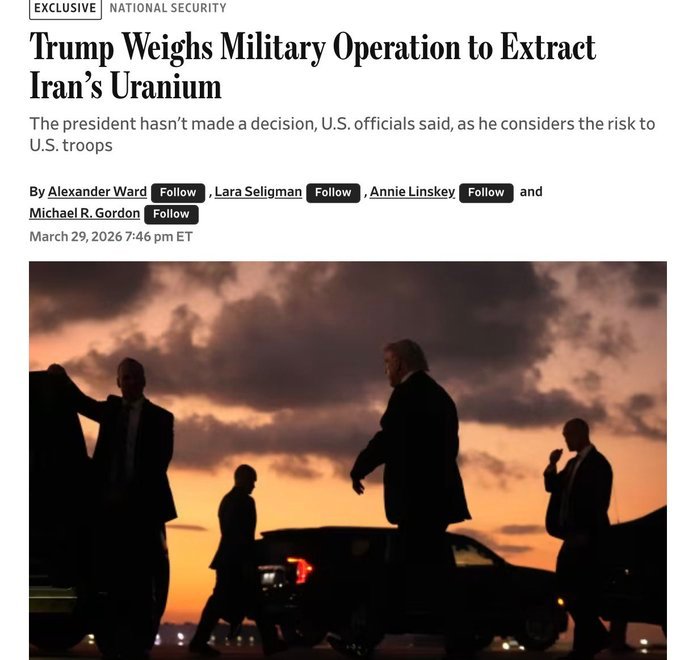
In what would be the most audacious ground operation of the month-long conflict, President Donald Trump is actively considering a high-stakes military mission to physically seize nearly 1,000 pounds (approx. 450 kg) of enriched uranium from within Iran. According to a report by the Wall Street Journal on Monday, March 30, 2026, the goal of the “snatch-and-grab” operation is to permanently strip Tehran of the fissile material required to assemble a nuclear weapon.
The Objective: Denying the “Breakout”
U.S. intelligence estimates that Iran has accumulated enough enriched uranium to potentially produce several nuclear warheads. While weeks of U.S.-Israeli airstrikes have damaged facilities like Khondab and Natanz, the WSJ reports that a significant portion of the stockpile remains intact in reinforced underground bunkers.
- The “Zero-Nuke” Goal: The administration believes that simply bombing the sites may lead to environmental disasters or leave the material salvageable.
- The Physical Solution: A ground mission would involve elite special operations forces (likely Delta Force or Navy SEALs) entering a hardened facility, securing the canisters, and extracting them via heavy-lift helicopters.
“Complex, Dangerous, and Not Quick”
Military planners have warned the White House that this is not a standard “hit-and-run” raid. The operation presents several extreme risks:
- Extended Presence: Unlike a drone strike, this mission would require U.S. boots on the ground inside sovereign Iranian territory for days, not hours, to safely neutralize security and bypass reinforced vault doors.
- The “Set it on Fire” Risk: High-ranking IRGC officials have already vowed to “set the region on fire” if U.S. troops enter the interior. A multi-day presence would give the IRGC ample time to mobilize “swarm” counter-attacks and “suicide” drone units.
- Radiation Hazard: Extracting 1,000 pounds of enriched material requires specialized containment and handling, significantly slowing the extraction process and increasing the “vulnerability window” for the transport teams.
The Strategic Trade-off: Peace Talks vs. Extraction
The consideration of this “risky mission” comes at a delicate moment for the “Islamabad Track” of negotiations.
- The Trump Ultimatum: The President recently stated that Iran is “gonna do everything that we want them to do,” or they “won’t have a country.”
- The Leverage: Critics argue that launching a ground raid to seize uranium could immediately collapse the indirect talks being facilitated by Pakistan’s Ishaq Dar, triggering the “historic lesson” and residential retaliation threatened by Tehran.
- The “Kharg” Alternative: This nuclear extraction plan is being weighed alongside the proposal to seize Kharg Island to “take the oil,” suggesting a multi-pronged “territorial” shift in U.S. strategy.
| Operation Parameter | Detail |
| Primary Target | ~1,000 lbs Enriched Uranium. |
| Mission Duration | Multi-day (Estimated). |
| U.S. Assets | Special Operations Command (SOCOM) / 82nd Airborne. |
| Key Risk | Total Regional Escalation / Capture of U.S. Personnel. |
Domestic and International Reaction
The WSJ report has already sent ripples through Washington. While some hawks argue that “taking the nukes” is the only way to ensure lasting security, others point to the “Winchester” concern—noting that U.S. forces are already stretched thin protecting 20,000 seafarers and maintaining a blockade.
President Trump has yet to officially authorize the mission, but his comments to the FT regarding “stupid people” who question his desire to “take the oil” suggest he is increasingly dismissive of those advising caution.
