
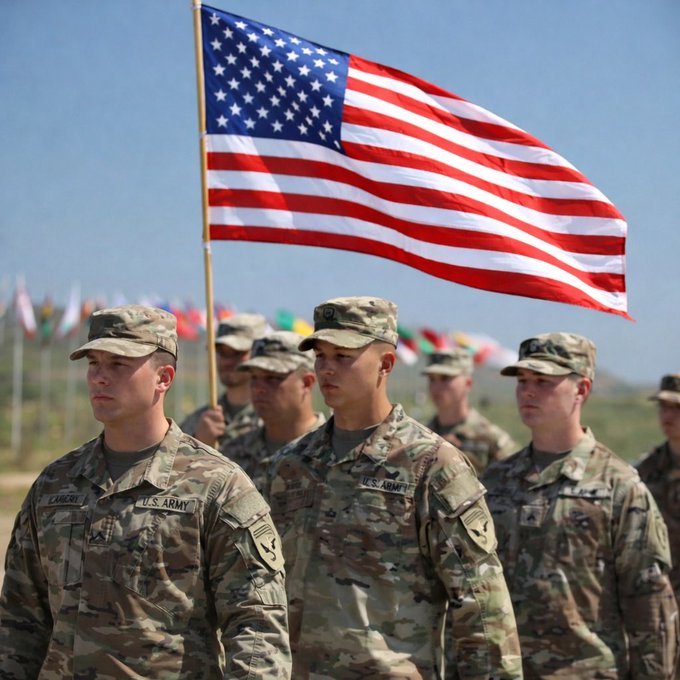
The number of United States military personnel deployed across the Middle East has exceeded 50,000, marking an increase of roughly 10,000 troops over standard regional baseline levels. According to a report by The New York Times on March 30, 2026, this surge is a direct response to the month-long war with Iran and is intended to provide President Donald Trump with expanded “military options” as the conflict enters a volatile new phase.
Strategic Buildup: 82nd Airborne and Marine Reinforcements
The recent spike in personnel follows several high-profile deployments ordered by the Pentagon over the last week:
- Elite Paratroopers: Approximately 3,000 soldiers from the U.S. Army’s 82nd Airborne Division (Immediate Response Force) have been moved into the region. While their exact location is classified, officials indicate they are stationed within “striking distance” of Iranian territory.
- Marine Expeditionary Units: Around 5,000 Marines and sailors—including those aboard the amphibious assault ship USS Boxer and the USS Tripoli—have arrived to bolster maritime security and rapid-response capabilities.
- Air Defense Expansion: Additional units have been deployed to operate Patriot missile interceptors, creating what CENTCOM describes as the “most expansive air defense network” ever established in the Middle East to counter Iranian drone and missile swarms.
Potential Objectives: Kharg Island and the “Toll Booth”
Military analysts and sources cited by the WSJ and NYT suggest that the additional 10,000 troops are not currently intended for a full-scale ground invasion of the Iranian mainland. Instead, the force is being positioned for specific contingencies:
- Securing Kharg Island: The paratroopers could be used to seize or neutralize Iran’s primary oil export hub, which handles 90% of the country’s crude.
- Unblocking the Strait of Hormuz: The increased naval and Marine presence is aimed at ending the “Tehran toll booth” regime, where Iran has been harassing or blocking international shipping.
- Regional Deterrence: Bolstering bases in Saudi Arabia, Jordan, and the UAE that have recently come under fire from IRGC-linked drones.
The “Winchester” Concern and Tactical Limits
Despite the 50,000-troop milestone, military experts warn that the force remains “too few” for a sustained occupation of a nation the size of Iran. Furthermore, internal Pentagon reports described by the World Socialist Web Site suggest that the high volume of munitions used—including over 850 Tomahawk missiles—has left some supplies “alarmingly low,” a state referred to in military slang as “Winchester.”
| Unit / Asset | Strength | Status |
| Regional Baseline | ~40,000 | Permanent stationing in Gulf/Levant. |
| 82nd Airborne | ~3,000 | Deployed; Rapid response capability. |
| Marine MEUs | ~5,000 | Arrived via USS Boxer/Tripoli. |
| Total Force | 50,000+ | Highest level in recent regional history. |
Political Fallout and the “America First” Counter-Narrative
The troop surge comes at a sensitive political moment. While President Trump claims the buildup is necessary to force Iran into a “15-point” peace deal, Iranian President Masoud Pezeshkian has used the deployment to claim that the American people are “tired of Israeli kings ruling over American democracy.” Domestically, U.S. polls show a slight dip in public support for the campaign, with approximately 61% of Americans expressing concern over the potential for a prolonged ground entanglement
