
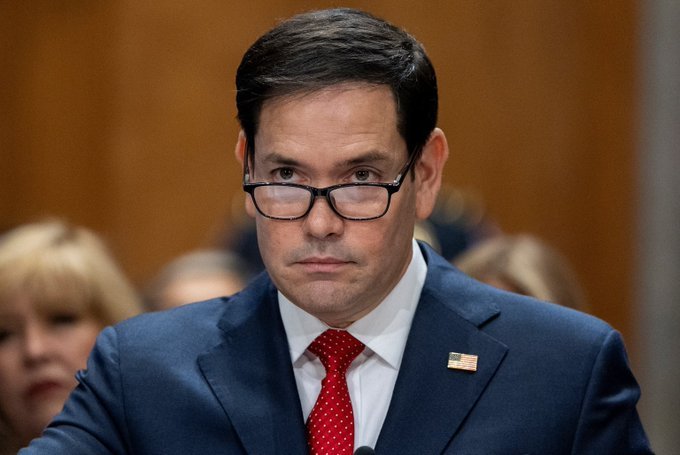
U.S. Secretary of State Marco Rubio issued a direct ultimatum to Tehran on Monday, March 30, 2026, demanding an immediate halt to the production of the drones and missiles that have fueled a month of regional escalation. In an exclusive interview with Al Jazeera, Rubio characterized Iran’s short-range arsenal as a purely offensive tool and signaled that the U.S. is committed to “finishing the job” of dismantling these capabilities.
“One Purpose”: Targeting the Gulf
Rubio’s remarks were specifically aimed at the threat posed to America’s regional partners. He argued that the weaponry manufactured by the Islamic Republic serves no legitimate defensive function.
- The Onslaught: “The short-range missiles launched by Iran serve only one purpose: to attack Saudi Arabia, the UAE, Qatar, Kuwait, and Bahrain,” Rubio stated.
- The Production Ban: He added that for any diplomatic resolution to hold, Iran must “stop manufacturing the drones and missiles we have seen recently.”
- Future Threat Assessment: Rubio challenged the network’s audience to imagine the regional landscape in three to five years if Iran were allowed to continue expanding its arsenal. “That was intolerable. That’s why this needed to be done,” he asserted.
Strategic Objectives: “Finishing the Job”
The Secretary’s interview aligns with a broader Pentagon effort to systematically target Iran’s military-industrial base.
- Systematic Destruction: Rubio confirmed that CENTCOM is currently carrying out the “systematic destruction” of Iran’s missile belt, including launchers and the factories responsible for their production.
- Ahead of Schedule: Despite reports of ongoing Iranian retaliatory strikes, Rubio maintained that the military operation—dubbed “Epic Fury”—is “progressing rapidly” and remains ahead of its primary objectives.
- The “Weeks, Not Months” Timeline: Rubio reaffirmed his expectation that the active phase of the conflict could conclude in “weeks, not months,” potentially without the need for a full-scale ground invasion.
The Diplomatic Counter-Track
While Rubio used the Al Jazeera platform to project military resolve, he also acknowledged the “direct and indirect” communications currently taking place.
- Trump’s Preference: Rubio noted that President Donald Trump “always prefers diplomacy” and is actively seeking a result through intermediaries.
- The Islamabad Proposal: The U.S. has reportedly delivered a 15-point proposal via Pakistan that requires Iran to curb its nuclear and missile programs in exchange for a cessation of strikes.
- Vision for the People: Rubio pivoted to a humanitarian argument, claiming that if the regime spent its wealth on infrastructure rather than “Shia militias” and “missile belts,” the Iranian people would not be facing the current economic and resource crises.
| U.S. Condition for De-escalation | Status (as of Mar 30, 2026) |
| Stop Drone/Missile Production | Non-negotiable Demand (Rubio) |
| Nuclear Rollback | Part of 15-point Pakistan Proposal |
| Hormuz Safe Passage | “Will happen one way or another” (Rubio) |
| End of Terror Sponsorship | Stated Strategic Goal |
Tehran’s Response: A Mocking Tone
The Al Jazeera interview has already drawn a sharp response from Tehran. Iranian state media and IRGC-linked accounts mocked the “selective” nature of the U.S. demands, especially as the first Chinese container ships successfully transited the Strait of Hormuz today under a “safe corridor” agreement that pointedly excluded U.S. and Israeli vessels.
