
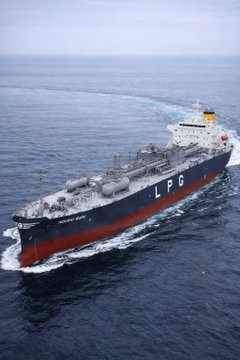
In a major relief for India’s domestic energy sector, two India-flagged Liquefied Petroleum Gas (LPG) tankers, the BW Elm and BW Tyr, have successfully transited the Strait of Hormuz. The vessels, which were previously anchored in the Persian Gulf due to escalating hostilities, are now heading toward Indian ports, signaling a breakthrough in the localized “energy blockade” that has gripped the region for several weeks.
The Strategic Importance of the Transit
The Strait of Hormuz is the world’s most sensitive maritime chokepoint, through which nearly one-fifth of the world’s oil and gas passes. For India, the stakes are even higher:
- Import Dependency: India relies on imports for roughly 60% of its LPG consumption.
- Source Concentration: Approximately 90% of these imports originate from the Middle East, primarily through this narrow waterway.
- Capacity: The BW Elm and BW Tyr carry a combined cargo of over 90,000 tonnes of LPG—enough to meet roughly three days of India’s total national demand.
Diplomacy and the “Non-Hostile” Protocol
The safe passage was not a matter of luck but the result of intense diplomatic maneuvering. Following a series of high-level calls between Prime Minister Narendra Modi and Iranian President Masoud Pezeshkian, Tehran has established a selective transit framework.
Under this system, Iran allows “non-hostile” vessels to transit provided they:
- Coordinate directly with Iranian maritime authorities.
- Navigate specific corridors—often hugging the Iranian coastline near Larak Island for visual verification.
- Identify clearly: Both tankers used their transponders to signal “INDIAN OWNER / INDIAN CREW” throughout the journey to avoid being targeted by missile or drone strikes that have plagued other commercial shipping.
Operation Urja Suraksha: The Naval Shield
While diplomacy opened the door, the Indian Navy provided the shield. Under the newly launched Operation Urja Suraksha (Energy Security), the Indian Navy has deployed destroyers and frigates to escort these high-value assets.
“We are providing route-specific guidance and layered maritime security to ensure our energy lifelines remain uninterrupted,” a senior naval official stated.
The Navy’s presence in the Gulf of Oman ensures that once tankers exit the Strait, they are protected from secondary threats such as piracy or stray munitions as they cross the Arabian Sea.
Impact on the Home Front
The arrival of these cargoes comes at a critical time. India has been grappling with its most significant gas crisis in decades. The government recently invoked the Essential Commodities Act to prioritize LPG for residential cooking, even cutting supplies to some industrial sectors to prevent household shortages.
While these two tankers represent only a fraction of India’s monthly needs, they signify a “trickle-to-flow” strategy. Including the Shivalik, Nanda Devi, Pine Gas, and Jag Vasant, at least six major LPG carriers have now successfully navigated the crisis zone.
Looking Ahead
The successful transit of the BW Elm and BW Tyr offers a blueprint for how India intends to manage its energy security in a fragmented world: Strategic Autonomy. By maintaining a neutral stance and leveraging its naval strength, India is managing to keep its kitchens running while other nations face severe rationing.
However, with nearly 18 Indian-flagged vessels still in the Persian Gulf and global oil prices hovering near $120 per barrel, the road to complete stability remains long.
