
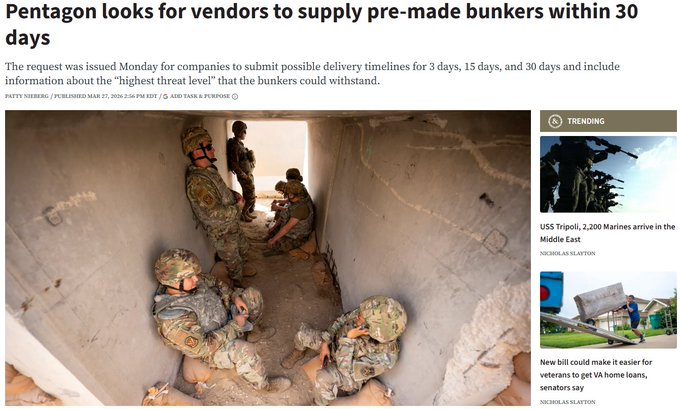
WASHINGTON — In a clear signal that the U.S. military is preparing for a “long-term presence” and potential ground escalation, the U.S. Department of Defense has issued an emergency solicitation for prefabricated, transportable bunkers. According to reports from Task & Purpose on Sunday, March 29, 2026, the Pentagon is seeking vendors capable of delivering high-durability shelters to the Middle East theater in as little as 72 hours.
The urgent request follows the devastating March 27 strike on Prince Sultan Air Base (PSAB), where 13 U.S. service members were killed and over 300 wounded, many while inside structures that failed to withstand Iranian ballistic missile fragmentation.
The “Rapid Response” Requirements
The federal notice emphasizes “immediate availability” and “expedited logistics,” reflecting the volatility of Operation Epic Fury as it enters its second month.
- Aggressive Timelines: The Pentagon has asked companies to provide tiered delivery schedules for 3, 15, and 30 days. The 3-day requirement suggests the military is looking to tap into existing regional stockpiles or “pre-staged” inventory in Europe and the Gulf.
- Threat Specs: Vendors must provide specific data on how their units perform against:
- Blast Overpressure: Resistance to high-explosive concussive waves.
- Fragmentation: Protection against “shrapnel spray” from drones and cruise missiles.
- Ballistic Impact: Defense against direct small-arms fire and indirect mortar strikes.
- Mobility: Bunkers must be “modular and transportable,” capable of being rapidly moved by C-17 Globemaster III or CH-47 Chinook to forward operating bases (FOBs) along the Iranian coastline.
Lessons from the “Infrastructure Blitz”
Defense analysts suggest the bunker push is a direct response to Iranian “saturation” tactics, which use swarms of Shahed-type drones to overwhelm air defenses and strike “soft” personnel targets.
- Hardening the “Rear”: While the U.S. has achieved air superiority, the “rear” bases in Saudi Arabia, Jordan, and the UAE remain vulnerable to long-range missile “leaks.”
- The Ground Phase Link: The request for “portable” bunkers aligns with recent Washington Post reports that the Pentagon is preparing for two-month-long ground operations. Troops moving onto Iranian territory (e.g., Kharg Island) would require immediate, hardened cover to survive counter-barrages.
- The “Vulnerability Gap”: A recent internal Army memo reportedly warned that existing “Hesco-style” barriers are insufficient against the latest generation of Iranian-made thermobaric warheads.
Bunker Logistics: The “3-Day” Challenge
| Feature | Military Requirement | Current Inventory Status |
| Delivery Speed | 3 to 30 Days | Critical Shortage in theater. |
| Material | Reinforced Concrete / Ballistic Steel | High-weight; requires heavy lift. |
| Capacity | 10 to 50 Personnel per unit | Modular “blocks” preferred. |
| Primary Deployment | Prince Sultan AB, Al-Asad, UAE Hubs | Focusing on “high-threat” flight lines. |
The “America First” Industrial Base
The solicitation specifically looks for “U.S.-based or allied” vendors, favoring domestic manufacturing to ensure supply chain security. This aligns with President Donald Trump’s recent directives to repatriate defense manufacturing and avoid reliance on “unreliable” global partners during wartime.
What’s Next?
The Pentagon is expected to award multiple contracts by April 1, with the first wave of “3-day” shipments likely arriving in the Gulf before the April 6 deadline for the 15-point peace proposal. If the diplomatic channel in Islamabad fails, these bunkers will be the primary defense for U.S. personnel during the expected transition to high-intensity ground raids.
