
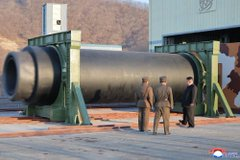
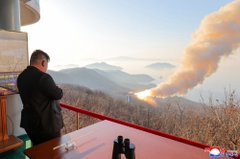
PYONGYANG — North Korean leader Kim Jong Un has overseen the ground jet test of a newly upgraded high-thrust solid-fuel missile engine, marking a 26% leap in power over previous models. According to reports from the Korean Central News Agency (KCNA) on Sunday, March 29, 2026, the new engine utilized advanced composite carbon fiber materials for its nozzle and reached a maximum thrust of 2,500 kilonewtons (kN) (approximately 255 tons-force).
The test is being characterized by Pyongyang as a “strategic milestone” in its five-year plan to modernize its nuclear strike capabilities, occurring amidst heightened global tensions and the ongoing U.S.-Israel-Iran war.
Technical Breakdown: The Hwasong-20 Powerplant
Military analysts believe this upgraded engine is the intended powerplant for the Hwasong-20, a next-generation solid-fuel Intercontinental Ballistic Missile (ICBM) currently under development.
- Thrust Evolution: The 2,500 kN measurement represents a significant upgrade from the 1,971 kN recorded during the “final” development test of a similar motor in September 2025.
- Carbon Fiber Innovation: The use of carbon-fiber composite materials in the nozzle allows the engine to withstand the extreme heat and pressure of a high-thrust burn while remaining lightweight, a critical factor for long-range missiles.
- The “MIRV” Objective: Defense experts suggest the primary goal of the increased thrust is not necessarily more range, but the ability to carry a Multiple Independently Targetable Reentry Vehicle (MIRV) payload. This would allow a single Hwasong-20 to deploy multiple nuclear warheads, potentially overwhelming U.S. missile defense systems.
Kim Jong Un’s Strategic “Task List”
Kim Jong Un reportedly expressed “great satisfaction” with the results, stating that North Korea’s defense capabilities have entered a “significant phase of change.”
- “Iron Fists” Demonstration: In addition to the engine test, Kim recently visited a special operations training base and oversaw the trial of a new-type main battle tank. The tank’s active protection system (APS) reportedly achieved a 100% success rate in intercepting anti-tank munitions.
- Nuclear Deterrence Messaging: Pyongyang has framed these tests as a direct response to the “rogue” nature of the United States, specifically citing the U.S.-Israeli strikes on Iran as proof of the need for a “crushing” nuclear deterrent.
- The Trump Factor: The tests come as President Donald Trump reportedly explores a potential late-March summit with Kim Jong Un in Beijing. By showcasing its advanced missile technology now, North Korea appears to be positioning itself to negotiate from a “position of strength.”
Comparative Solid-Fuel Engine Progress
| Test Date | Engine Type | Max Thrust | Material | Intended System |
| March 29, 2026 | Upgraded High-Thrust | 2,500 kN | Carbon Fiber Composite | Hwasong-20 (ICBM) |
| Sept 8, 2025 | High-Thrust Ground Jet | 1,971 kN | Carbon Fiber Composite | Hwasong-20 Prototype |
| Dec 15, 2022 | First High-Thrust Test | 1,400 kN | Conventional Steel/Alloy | Hwasong-18 (ICBM) |
What’s Next?
South Korean and U.S. intelligence agencies are reportedly “closely monitoring” the Sohae Satellite Launching Ground and other test sites for signs of a full-scale flight test of the Hwasong-20. If North Korea chooses to mark the upcoming April 15 holiday (Day of the Sun) with an ICBM launch, it would signal a major escalation in the Pacific theater, potentially forcing the U.S. to divert strategic assets currently focused on the Middle East.
