
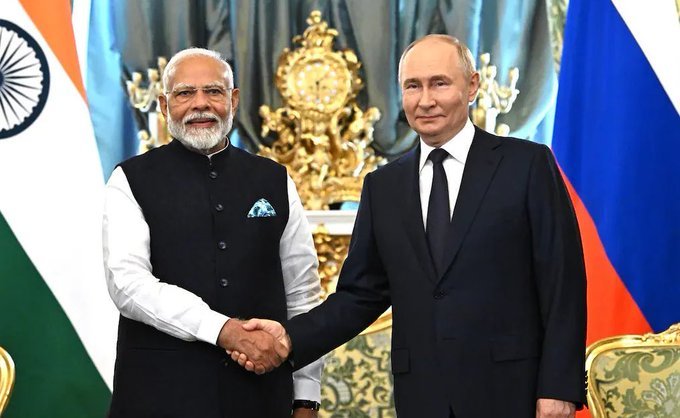
NEW DELHI — In its largest single-day defense expansion in history, the Indian government on Friday, March 27, 2026, approved military procurement proposals totaling $25 billion (₹2.38 lakh crore). The center-piece of the package is the formalization of five additional S-400 Sudarshan long-range missile squadrons from Russia, a move that signals New Delhi’s return to its “time-tested” Moscow partnership as the U.S.-Israel-Iran war destabilizes global energy and security.
The decision brings India’s total defense approvals for the current fiscal year to a record-breaking $71 billion, as the Ministry of Defence moves to replenish stocks depleted during the 2025 “Operation Sindoor” conflict with Pakistan and prepare for regional spillover from the Gulf.
The “Russian Pillar”: S-400s and Tunguskas
Despite the threat of U.S. sanctions under CAATSA, India has doubled down on Russian hardware to secure its airspace.
- S-400 “Sudarshan” Expansion: The Defence Acquisition Council (DAC), chaired by Rajnath Singh, approved five new squadrons of the S-400 system. This is in addition to the original 2018 contract; the fourth squadron of that initial deal is expected to arrive by May 2026.
- Replenishment Order: India formally ordered 288 interceptor missiles (120 short-range, 168 long-range) for existing S-400 batteries to replace inventory used in recent border skirmishes.
- Tunguska Systems: A separate $47 million (₹445 crore) contract was signed today with Russia’s Rosoboronexport for Tunguska mobile air-defense systems to protect Army columns from drone swarms—a lesson learned from the ongoing “Baltic Blitz” in Russia and the drone war in Iran.
Air Force & Army: The “Big Ticket” Items
The $25 billion windfall covers critical gaps across all three services, with the Air Force emerging as the primary beneficiary.
- Medium Transport Aircraft (MTA): Approval was granted to replace the aging Russian-era An-32 and Il-76 fleets with 60 new transport aircraft. Competitors are expected to include Lockheed Martin (U.S.), Embraer (Brazil), and Ilyushin (Russia).
- Su-30 Engine Overhaul: A massive life-extension program for the Sukhoi-30 MKI fleet was greenlit, ensuring India’s air superiority fighters remain operational through the 2030s.
- Dhanush & BrahMos: The Army received the nod for 300 indigenous Dhanush howitzers and a massive order of 800km-range BrahMos cruise missiles, a joint venture with Russia that has seen increased indigenization in its final production stages.
Geopolitical Pivot: Reheating the Moscow Connection
Analysts suggest that the Trump administration’s war on Iran has forced India to diversify its strategic dependencies after years of drifting toward Washington.
| Factor | Impact on India’s Strategy (March 2026) |
| Energy Shock | India is discussing doubling Russian crude imports to 40% to offset the Strait of Hormuz closure. |
| Sanctions Risk | New Delhi has reportedly approached Washington for a “conflict-specific” sanctions waiver regarding the new S-400 deal. |
| Regional War | The use of long-range missiles in the Iran conflict has convinced Indian planners that “theatre-wide air denial” is the only viable defense. |
| Pakistan Factor | Replenishing stocks after Operation Sindoor remains the top priority for the Northern and Western fronts. |
What’s Next?
With the April 6 deadline looming for the U.S.-Iran peace deal, India is racing to secure its “Northern Corridor” for trade and energy. A high-level Indian defense delegation is scheduled to arrive in Moscow next week to finalize the delivery schedule for the newly approved systems. Domestically, the government is also expected to move forward with Project Kusha, an indigenous long-range SAM system designed to eventually complement the S-400 umbrella.
