
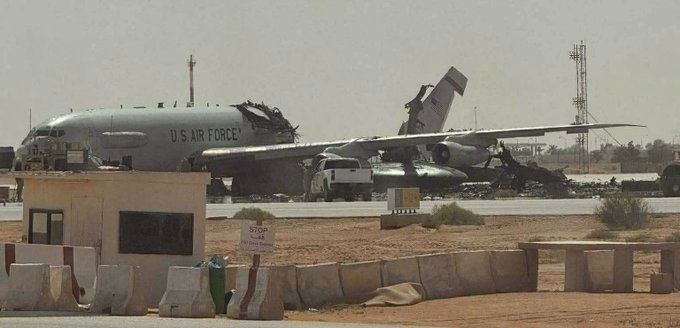
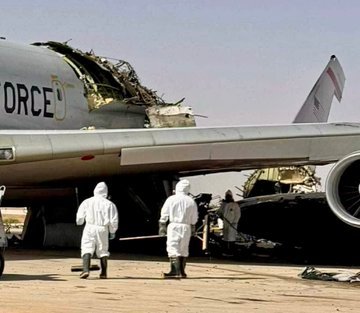
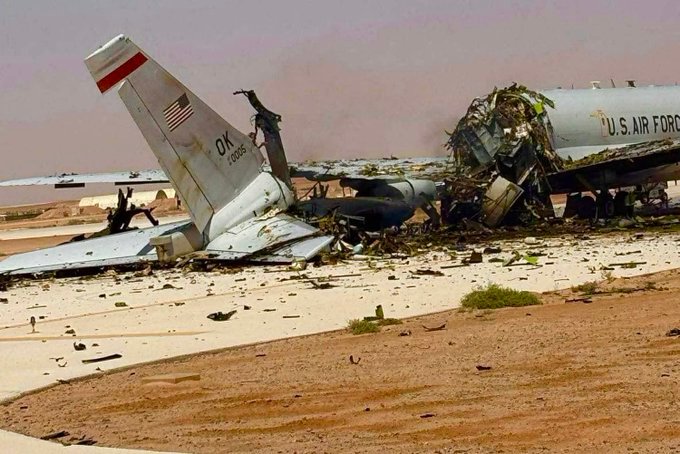
PRINCE SULTAN AIR BASE, SAUDI ARABIA — A devastating Iranian ballistic missile and drone barrage has resulted in the confirmed destruction of at least one U.S. Air Force aircraft and significant damage to several others at Prince Sultan Air Base (PSAB). In a video statement released on Saturday, March 28, 2026, Iranian military spokesperson Ebrahim Zolfaghari claimed that one refueling aircraft was “completely destroyed,” while satellite imagery suggests the loss may be even more strategically severe.
The attack, which occurred on Friday, March 27, is being characterized by defense experts as a deliberate “asymmetric counter-air campaign” designed to blind and ground the U.S. aerial offensive.
The “High-Value” Targets
Initial damage assessments from the Pentagon and independent satellite analysis highlight a critical blow to the Air Force’s “force multipliers.”
- The E-3 Sentry (AWACS): Verified imagery shows “significant and likely unrepairable” damage to an E-3 Sentry AWACS command-and-control plane. This aging but vital aircraft is the “eyes and ears” of the theater, responsible for airspace deconfliction and targeting. Experts warn its loss will create immediate “blind spots” in the coalition’s battlespace awareness.
- Refueling Tankers (KC-135s): Iranian state media and satellite photos from Sentinel-2 confirmed that at least one KC-135 Stratotanker was incinerated on the tarmac, with three others sustaining major damage. These “flying gas stations” are the only reason U.S. fighters can reach targets deep inside the Iranian mainland.
- The “Fireball” Signature: Short-Wave Infra-Red (SWIR) satellite data captured intense heat signatures at the base’s parking aprons, corroborating reports of aircraft burning for several hours post-impact.
Casualties and the Scale of the Barrage
The strike was one of the most sophisticated launched by Tehran since the war began on February 28, reportedly overwhelming local defenses through sheer volume.
- The Munitions: Iran utilized six ballistic missiles and 29 kamikaze drones in a coordinated “saturation” strike.
- U.S. Personnel Injuries: The casualty count has been revised upward to 15 U.S. service members wounded, with at least five in serious condition. Most of the injured were inside a building that took a near-direct hit from a missile.
- Historical Toll: This base has now seen 13 U.S. fatalities since the conflict started, including the death of Sgt. Benjamin N. Pennington earlier this month. Total U.S. casualties in Operation Epic Fury have now surpassed 300.
Strategic Impact: “Reaping What We Sowed”
Defense analysts are sounding the alarm over the fragility of the U.S. fleet of high-value support aircraft.
- Attrition Stress: “The loss of even one E-3 is incredibly problematic,” noted Heather Penney, a former F-16 pilot. “We have not invested in these battle management aircraft for decades, and we are now reaping what we sowed.”
- Zelensky’s Intel Claim: Ukrainian President Volodymyr Zelensky claimed today that Russian satellites provided the precise “target coordinates” for the base just 48 hours before the strike, arguing that Moscow is “100% aiding” the destruction of U.S. assets.
The “Infrastructure Blitz” Response
| Entity | Official Stance |
| U.S. CENTCOM | Declined to comment on specific aircraft losses; confirmed “some damage.” |
| IRGC | Claimed a “total success” in neutralizing “the eyes of the Great Satan.” |
| The White House | President Trump maintains that the U.S. is “crushing Iran’s stockpiles,” despite the PSAB losses. |
What’s Next?
The destruction of these “critical enablers” puts additional pressure on the April 6 deadline. Without sufficient AWACS and tanker support, the U.S. may be forced to either scale back its “Infrastructure Blitz” or accelerate the ground operation plans recently reported by the Washington Post to secure the Iranian coastline and remove missile threats once and for all.
